Help/Messages and calls
Transcripts
When a call starts on your Mac or PC, Orbit can transcribe it without joining. Afterwards you get a summary, decisions, your actions on the Planner and a follow-up email draft.
Transcripts work on Mac and on Windows 11 and Windows 10 (version 2004 or later). Your plan includes 20 hours of calls a month, across all your computers. On Windows, the first call asks for microphone permission: click Yes (or allow Orbit in Windows Settings, Privacy & security, Microphone).
How it works
- Join a call as normal: Zoom, Google Meet, Microsoft Teams, Slack huddles, FaceTime, Webex or another app.
- A small window asks Transcribe this call? Click Yes, No, or Always for that kind of call (for example Always for Zoom).
- While it listens, the window shows the latest line and a stop button. Nobody joins the call, and nothing is recorded until you say yes.
- When the call ends (or you click stop), Orbit writes it up. If it can't tell which project the call was for, it asks Which project was this for?
Already on a call and missed the prompt? Open Transcripts in the left rail and click Transcribe now.
What you get afterwards
Open Transcripts and pick a call. Each one has:
| Section | What's in it |
|---|---|
| Summary | What was discussed and agreed, in a few plain sentences. It's added to the project's card too. |
| Decided | Each decision, one line each. |
| Actions | What people agreed to do, with who and by when. Your own actions become tasks on the Planner. |
| Follow-up email | A short, friendly follow-up from you, waiting in the Inbox's Flagged tab for your OK. It's never sent by itself. |
| Transcript | The full call, line by line, marked You or Them. |
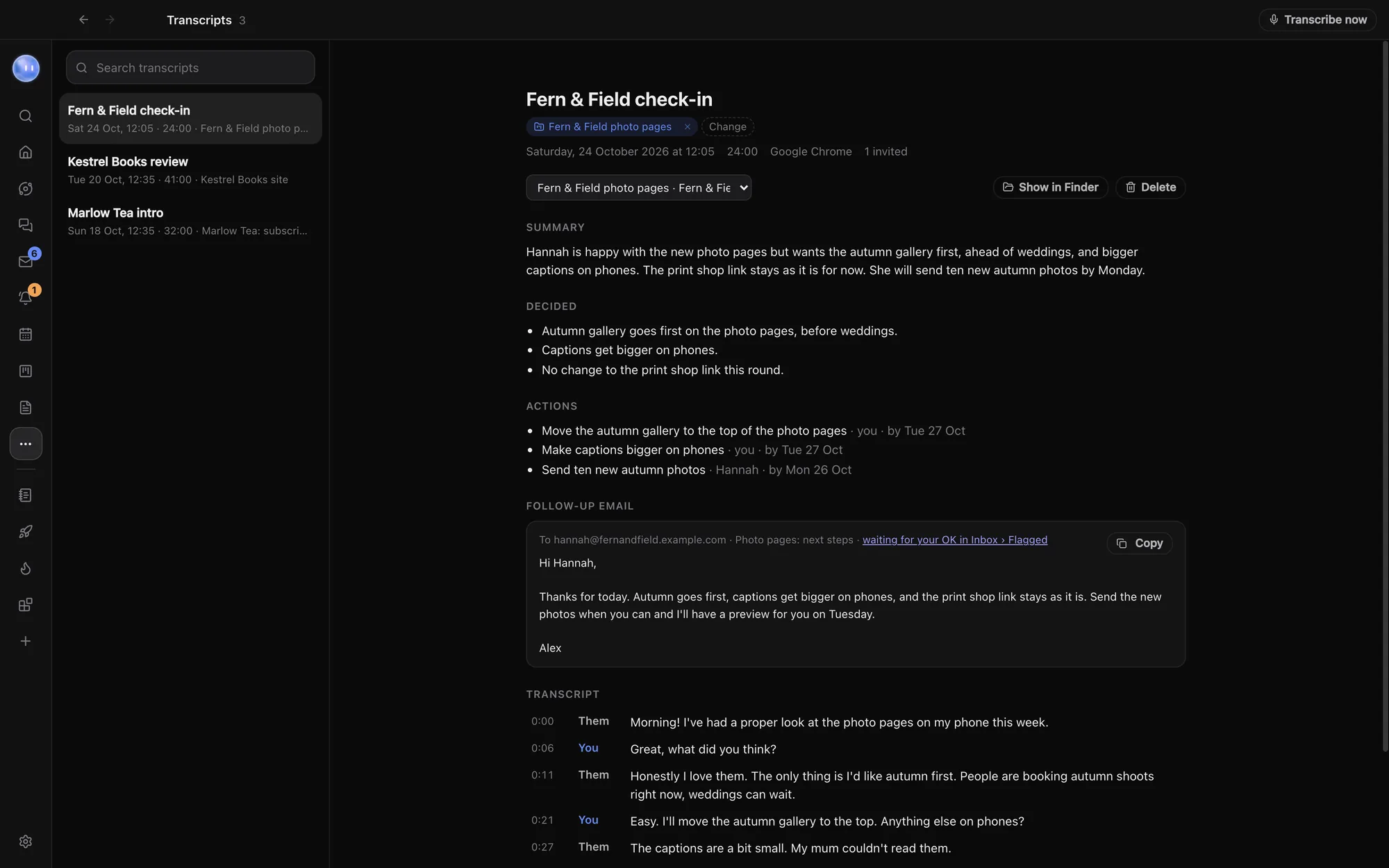
Change the call's project from the menu at the top, open the transcript in Finder (File Explorer on Windows), or delete the call. Search transcripts searches what was said across every call.
Settings
Open Settings, then Transcripts:
- Offer to transcribe calls: turn the whole feature on or off.
- One row per kind of call (Google Meet, Zoom, Microsoft Teams, Slack huddles, FaceTime, Webex, Other calls), each set to Ask, Always or Never. Other calls covers Discord, WhatsApp, Whereby and the like, and anything using the microphone during a meeting on your calendar.
- Language: what calls are spoken in: English (UK, US, Australia or Ireland), French, German, Spanish, Italian or Portuguese.
- Keep the audio: off keeps only the transcript; on saves the audio beside it, on your computer.
- Check browser tabs (Mac): lets Orbit tell a Meet or Teams tab apart from another site using the microphone. macOS asks once per browser. On Windows, Orbit goes by the browser window's title instead.
- This month: how much of your 20 hours is left. It starts again on the 1st of each month.
Privacy
While a call is transcribed, its audio (your microphone, and the other people as you hear them) streams from your computer straight to AssemblyAI, which turns it into text, is set to delete the audio and text after a day, and never uses them to train its models. Orbit's server only hands your computer a short-lived pass for each call and counts the minutes; it never receives the audio or the words. Transcripts, and any audio you keep, are saved only in Orbit's folder on your computer. To write the summary, actions and follow-up, Orbit sends the transcript to the AI model you've connected, like anything else you'd send it. Let the people on the call know you're transcribing it.
Common questions
Does Orbit join the call as a bot?
No. It listens on your computer, the way you hear the call. Nobody else sees Orbit in the call.
What happens when my 20 hours run out?
The window says so instead of offering to transcribe, and a call that's being transcribed when they run out is marked as cut short and written up from what was heard. They come back on the 1st of the next month.
Does it need the internet?
Yes. Calls are turned into text in the cloud, so Orbit needs to be online and signed in to your Orbit account.
Why didn't the prompt appear?
Check that Offer to transcribe calls is on and that kind of call isn't set to Never. On a Mac, for browser calls, allow Check browser tabs when macOS asks. On Windows, keep the call's browser tab in front when it starts, so its window title shows it's a call. You can always start one with Transcribe now.
Related: Drafts and replies, Voice calls, Planner.
Updated 24 October 2026 · Orbit 0.1.15